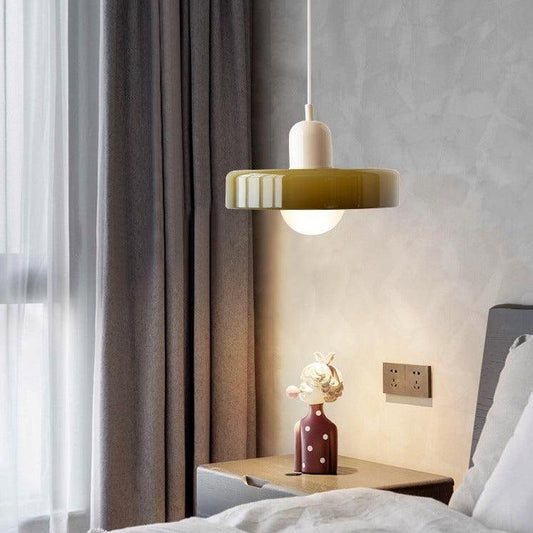
How Much Should a Good Pendant Light Cost? What You Actually Pay For
Short answer: there's no single "right" price, because the market is extremely wide. At the time of writing (November 2026), a basic plastic or paper shade on a big-box retailer's German website costs from about €4, while a licensed design classic such as the 50 cm Louis Poulsen PH 5 is listed at around €919 at a European design retailer. A good pendant for an everyday home usually sits somewhere between those extremes. What separates a good one from a bad one is not the number on the tag. It's the materials, the build, the quality of the light, the safety paperwork and the design rights you're paying for. This guide explains each one, so you can tell whether a price is fair.
Why pendant light prices vary so much
Two pendants can look almost identical in a product photo and still differ in price by a factor of ten. The gap usually comes down to five things:
- Materials: solid metal versus thin sheet or plated parts, handmade glass versus pressed glass or acrylic, real stone or wood versus printed "optic" finishes.
- Construction: how the shade is joined, how the socket is held, the quality of the cable, ceiling canopy and suspension.
- Light quality: what light source it takes, or ships with, and how good that light is.
- Compliance and support: safety marking, documentation, spare parts and the ability to replace the light source.
- Design rights and brand: whether you're buying a licensed original, an independent design or a design "inspired by" a classic.
None of these is automatically worth paying for. A cheap paper lantern can be exactly right for a guest room. But it helps to know which ones you're getting for your money.
The market in tiers
The tiers below are a general picture of the market, not fixed price bands. Shops and currencies differ, and so do sales.
| Tier | What you typically get | Typical trade-offs |
|---|---|---|
| Entry level (mass-market shades and kits) | Simple paper, plastic, fabric or thin metal shades, often sold with a separate cord set. The cheapest examples at big-box retailers cost a few euros. | Limited choice of materials and sizes. Very thin parts can dent, yellow or wobble. Good value if you accept the simplicity. |
| Mid-market design pendants | Glass, ceramic, solid wood, stone, woven natural fibres and powder-coated metal, often with adjustable cables and several sizes or finishes. | Quality varies the most here. Read the material descriptions carefully, and check the socket type and what's included. |
| Licensed design classics and premium brands | Original designs produced under licence (for example the PH 5, designed by Poul Henningsen in 1958), with documented materials, long production histories and dealer support. | Much of the price pays for the design, the brand, and small-batch or specialist production. Excellent products, but the light itself is not necessarily ten times better. |
What you actually pay for
Materials you can feel
Material is the most visible cost driver, and the easiest one to judge in person:
- Glass: handmade or mouth-blown glass has small variations and more depth. Pressed glass is more uniform. Acrylic is lighter and less fragile but can look flatter. Thick glass also means a heavier, more stable pendant.
- Metal: heavier gauge metal with a durable coating resists dents and fading. Plated finishes, such as brass-coloured over steel, cost less than solid brass but can show wear at edges over time.
- Natural materials: stone, solid wood and ceramic are heavier and more expensive to ship. Each piece varies slightly, which many people find to be the point.

Natural stone costs more to cut, finish and ship. The travertine stone pendant is made from genuine travertine, so every lamp has its own texture.
Construction you only notice later
Some of the most important quality differences are hidden. Look for a socket that is firmly fixed and not twisting in the shade, a cable that is thick enough and neatly strain-relieved, a ceiling canopy that fully covers the outlet, and a suspension system that holds the height you set. An adjustable cable is a practical feature, not just a nice extra. It means the pendant can follow you to the next table or the next home. (For how high to set it, see our dining table pendant height guide.)
The quality of the light
A lamp is only as good as the light it produces. Whether the pendant uses a standard bulb or a built-in LED, check:
- Colour rendering: Germany's consumer advice centres (Verbraucherzentrale) recommend a CRI (Ra) of at least 80, and ideally above 90 for kitchens and dining areas.
- Lifetime: the Verbraucherzentrale notes that most LED lamps on the market are rated around 25,000 operating hours. Some manufacturers claim far more.
- Colour temperature and brightness: warm white is 2,700–3,300 K, and about 700 lumens matches an old 60 W incandescent bulb. Our article on warm white vs cool white covers which to choose where.
- Dimming: many LEDs are not dimmable, and some flicker with older dimmers. Check before you buy.
A pendant with a standard socket, such as E27, lets you upgrade the bulb at any time. That's useful, because a budget pendant with a good bulb often lights a table better than an expensive pendant with a poor one.
Safety and paperwork
Mains-powered lamps sold in the EU must carry a CE mark, the manufacturer's declaration that the product meets EU safety requirements. Since the EU's ecodesign rules for lighting (Regulation (EU) 2019/2020) came in, manufacturers of lamps that contain light sources must make sure those light sources can be replaced with commonly available tools and without permanently damaging the product, unless there is a documented technical reason. They must also tell buyers whether the light source can be replaced by the end user or only by a qualified person. That information is meant to be on the packaging and in the instructions. For a lamp you expect to keep for ten years, that's worth checking. A pendant with a built-in LED that can't be replaced may end up in the bin when the LED fails.
Design rights and the name on the box
Licensed classics cost what they do partly because you're buying a specific, documented design from the company that holds the rights, often with decades of production history behind it. Independent and "inspired-by" designs cost less because they don't carry that licence or brand. That's a legitimate choice, as long as the product is honestly described. Be wary of listings that use a famous designer's name to suggest an original when the price makes clear it isn't one.

Solid wood rather than a printed wood effect: the solid wood pendant comes in several shapes, as single pendants or three-light chandeliers.
Where it pays to spend more, and where it doesn't
Worth spending on
- The pendant you see every day, especially over the dining table or kitchen island. You'll look at it for years.
- Solid materials and a sturdy build in high-use places, where cheap parts tend to fail first.
- A replaceable light source or a standard socket, so the lamp outlives its first bulb.
- Good bulbs. A high-CRI, warm-white bulb is one of the cheapest upgrades in lighting.
Fine to save on
- Guest rooms, hallways and spaces you pass through.
- Trend pieces you expect to change in a few years.
- Rooms where the pendant is mostly decorative and other lamps do the real work.

Ceramic gives a solid, matte shade with real weight. The ceramic flower pendant works singly or in a cluster.
A five-minute quality check before you buy
- Read the materials line. "Glass", "solid wood" and "natural stone" mean something. "Wood optic" or "metal look" mean a finish or print.
- Check the socket and light source. Is it a standard socket such as E27, GU10 or G9, or a built-in LED? Can the light source be replaced, and by whom?
- Look at the cable and canopy. Is the cable length adjustable? Is it long enough for your ceiling?
- Look for the CE mark and clear instructions in a language you can read.
- Compare like with like. A 50 cm pendant in metal and glass is a different product from a 25 cm one in acrylic, even if the photos look similar.
When you've found a material you love, browse our pendant lights and chandeliers. Glass lovers might start with the Italian retro pendant, which has a handmade glass shade and adjustable height.
Frequently asked questions
Is an expensive pendant light worth it?
Sometimes. You're paying for a licensed design, specialist materials and long-term support, and for a piece you'll keep for decades that can be good value. But price alone doesn't guarantee better light. That depends mostly on the light source and on how well the pendant is placed.
Why are designer pendant lights so expensive?
The price covers design rights or licence fees, smaller production runs, specialist materials and processes, dealer networks and long product support. The materials alone rarely explain the whole difference.
What should a cheap pendant light have at minimum?
A CE mark, a securely fixed socket, a sound cable and canopy, and a light source you can replace. With those, an inexpensive pendant can serve you well, especially with a good bulb.
Do LED pendants cost more to run than bulb pendants?
No. If anything, the opposite. The running cost depends on the light source, not the fixture. LEDs use far less electricity than old incandescent bulbs for the same brightness, whether they're built in or screwed in.
The bottom line
A good pendant light doesn't have to cost a fortune, but it shouldn't be judged by price alone either. Pay for real materials where you'll see and touch them, insist on safety marking and a replaceable light source, put your money into a good bulb, and decide consciously whether a famous name is worth the premium to you. Do that, and whatever you spend will be money well spent.
Sources
- Verbraucherzentrale: LED-Lampen – worauf Sie beim Kauf achten sollten
- Commission Regulation (EU) 2019/2020, ecodesign requirements for light sources (Article 4)
- IKEA Germany: pendant lights category (entry-level price reference, November 2026)
- Westwing: Louis Poulsen PH 5 pendant listing (premium price reference, November 2026)
Cover photo: Etienne Girardet on Unsplash